Introduction
Let’s start with a scenario almost every haulier has faced at some point.
You’ve got a flatbed sat in the yard because this week’s job is bagged fertiliser. Meanwhile, your tipper is sitting doing nothing because next week’s work is a 40ft container. Two trailers. Two sets of paperwork. Two chunks of working capital. Only ever one of them generating revenue at any time.
A Sidewall Semi Trailer is designed to solve that problem. High sides for loose material, twist locks for containers. All on one deck.
Below you’ll find seven reasons operators worldwide keep returning to this trailer design, complete with specifications to suit each application.
7 Advantages of a Sidewall Semi Trailer for Bulk and Container Work
One Trailer for Bulk Cargo and Shipping Containers
That’s the key headline point, and it is absolutely no exaggeration. The sidewalls keep loose and bagged cargo secure; grain, fertiliser, cotton, animal feed, bricks, bags of cement, steel bars, timber. Drop or remove them, and you get the same deck, but now with container twist locks fitted.
That trailer that carried maize to the port on Tuesday could easily bring back a container on Wednesday. Running as a Shipping Container Semi Truck one day, a bulk haulage rig the next – that’s exactly why owners-spec buyers favour them, and why you’ll find them used so heavily in border-crossing fleets, where the return load is never certain.
Payload Range from 30 to 100 Tons Across Axle Options
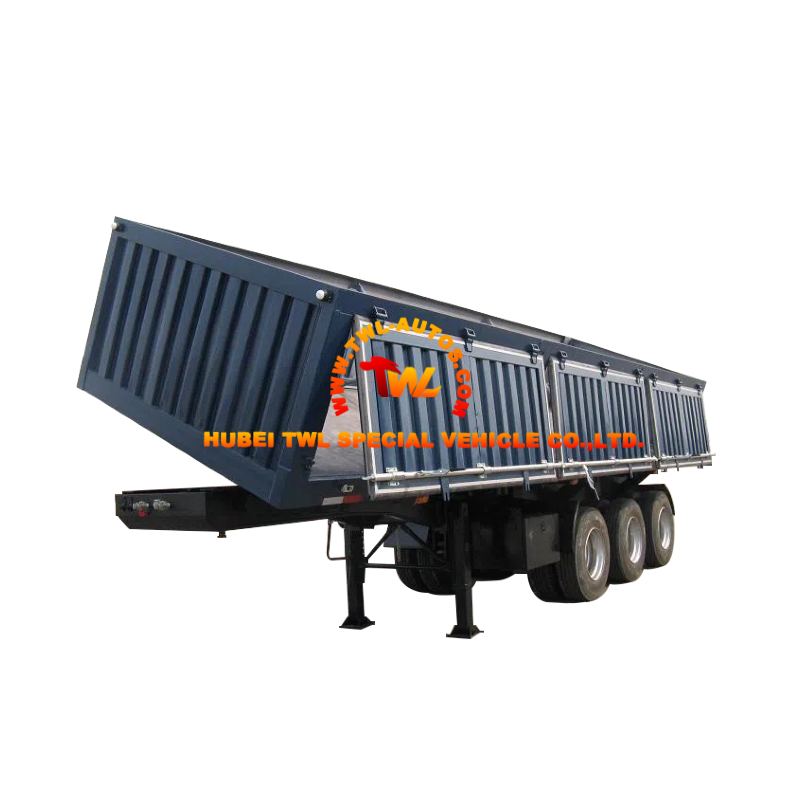
TWL’s Sidewall Trailer comes in configurations carrying between 30 and 100 tons. Exact payload depends mostly on how many axles your trailer has.
- 2 axles = ~50 tons. Ideal for lighter duty, regional runs.
- 3 axles = ~60 tons. By far the most popular configuration among fleets.
- 4 axles = ~80 tons and up. For operators who regularly move big tonnage on routes that allow it.
IMPORTANT: pause for a moment – national axle weight limits are NOT your trailer deciding how much you can legally carry. Check those before committing to twin or four axle configurations.
Why? Because trailer rated at 80 tons may offer tiny comfort if you’re limited to 45 tons by law.
Removable Sidewalls for Side and Overhead Loading
Sidewall heights come in 600 mm, 800 mm or 1,000 mm, and each is available in either fixed or removable styles. Sidewalls can also be either corrugated or flat panelling.
The removable option is important for giving you flexibility in loading. Forklift access from the side, rather than having to run the length of the deck. Being able to use a crane to lift cargo straight into the trailer. Fixed sidewalls are stronger and less expensive, so if side loading is never going to be a factor for you then fixings are the way to go.
Guidance here follows standard logistics theory – bulkgoods with low weight to volume tend to fill 1,000 mm decks fast. Dense materials like cement or steel will hit weight limits long before they reach the top of a 600 mm deck. Don’t pay extra for sidewalls you don’t need.
Twist Locks for 20ft and 40ft Container Hauling
You’ll notice twist locks in the image above. They’re what allow a Sidewall Trailer to seamlessly change between bulk cargo mode and container hauling.
TWL include twist locks for both 20ft and 40ft containers fitted as standard. They take up zero space when flattened for bulk work, and don’t interfere with loading in any way.
If you even THINK you might do container work sometime in the future, bloody well specify them. Having twist locks fitted after manufacturing your trailer is a pain, costly and always takes longer than you think. They’re cheap to include now.
Q345B Steel Frame Built for Rough Terrain Routes
Frame construction uses Q345B high tensile steel throughout. Twin 8 mm main beams support a 14/8/16 mm I-beam structure.
Strength where you need it, without excess weight you don’t. The trailer isn’t going to lose any payload capacity because its frame is fancy. Prior to construction, the chassis receives a shot blast surface before anti-rust paint is applied. Again, not a sexy detail but very important where your trailers will see salt and high humidity.
Suspension Choice Matched to Your Road Conditions
We’ve got three suspension configurations available. Again, getting this right will save you money both upfront and in maintenance.
Mechanical leaf spring is tough as nails, easily repaired anywhere and isn’t fussy about poor roads. Air suspension is far cushier, both for your cargo and driving height at loading docks. Air will let you adjust that second axle up or down to suit. But it’s more expensive, and if it goes belly-up you’ll need a qualified tech who knows air suspension to fix it.
Single-point is a hybrid of the two and usually serves mixed conditions very well.
Tip: choose your suspension for the worst roads you drive, not the best. Axles are available from FUWA or BPW, brakes are dual-line ABS stopping power, and all lights come via a 24V system pre-wired with safety markers.
Lower Fleet Cost Than Running Separate Trailers
Let’s do a quick cost breakdown. Purchasing a flatbed costs X, hitched to container payloads earns you X divided by Y.
Add a sidewall trailer into the mix for your bulk cargoes. Now you’ve got X times 2 to spend, because every time you bought a trailer you need to register it, insure it, buy it some tyres… that deck starts costing you money whether it is working or not.
Half those costs by using one trailer for both jobs. Utilisation skyrockets, because there’s no such thing as an undesirable load when you can do both. And maintenance becomes simpler across the board, your service department only has one trailer type to stock parts for.
Summary again – if you run a smaller fleet this can be the deciding factor between profit and loss at year-end.
Sidewall Semi Trailer Specifications Table: 2, 3 and 4 Axle
2-Axle, 3-Axle and 4-Axle option details below.
| Specification | 2-Axle | 3-Axle | 4-Axle |
| Typical payload | Around 50 tons | Around 60 tons | Around 80 tons |
| Overall payload range | 30–100 tons across the full range | ||
| Sidewall heights | 600 / 800 / 1000 mm | 600 / 800 / 1000 mm | 600 / 800 / 1000 mm |
| Sidewall type | Removable or welded | Removable or welded | Removable or welded |
| Wall style | Straight or corrugated | Straight or corrugated | Straight or corrugated |
| Frame steel | Q345B high-tensile | Q345B high-tensile | Q345B high-tensile |
| Beam structure | 14/8/16 mm I-beam, 8 mm main beams | Same | Same |
| Container twist locks | 20ft and 40ft | 20ft and 40ft | 20ft and 40ft |
| Suspension options | Mechanical, air or single-point | Same | Same |
| Axles | FUWA or BPW | FUWA or BPW | FUWA or BPW |
| Braking | Dual-line ABS | Dual-line ABS | Dual-line ABS |
| Best suited to | Regional, lighter loads | General fleet work | High tonnage, permitting routes |
Which Configuration Suits Your Cargo and Routes?
Answer these questions for yourself, and you’ve pretty much nailed what you need.
- “What do I carry most often?” – If it’s light bulky cargo, argue for 1,000mm sidewalls. Heavy dense material? 600mm will likely suffice, with more axles to spread weight.
- “How brutal are my roads?” – If you cover decent highways all the time, air suspension has a lot to offer. Unsealed or corrugated surfaces? Mechanical leaf spring options will thank you, because they can take a beating and any trucker can fix them.
- “Will I haul containers?” Maybe? TWL recommend specifying twist locks regardless because they cheap now and expensive to have fitted later. Don’t make your sidewall semi trailer into a regular dummy by omitting them.
Why Choose TWL for Your Sidewall Semi Trailer
TWL are one of many brands housed under the umbrella CLW Group. Their factory is located in Suizhou City, in Hubei Province. Otherwise known as where most of China’s special vehicle output occurs.
Production plants are ISO 9001 and ISO 14001 certified. Every trailer shipped will leave the factory with full export documentation prepped. That covers your ability to resell them should you choose, but also makes ordering spares easier down the track.
Lifetime on vehicles is sold as 12 months to 25,000 – 50,000 kms, whichever happens first. Sound impossible? Parts are delivered free of charge Australia-wide during that period, excluding wear items. They’ll also stay available via TWL at manufacturing cost when warranties expire.
TWL Runs 24 hour after sales service, which covers everything from enquiries through to ordering parts. Manuals and video guides are provided on delivery too.
Other advice; TWL suggests purchasing USD 500 – 800 worth of basic spare parts when you take delivery of your new trailer. Container hinges, straps, seals and bulk netting. Trust us. Also free shipping as long as the trailer trucks it.
FAQ
Can a sidewall semi trailer carry 20ft and 40ft containers?
Sure, as long as twist locks are fitted. TWL ships these positioned for either container length, meaning you can carry either one 40ft, or two 20ft containers secure. Remember to specify twist locks when you place your order though, as adding them after construction starts is a labour and cost intensive process.
What payload can a 3-axle sidewall semi trailer handle?
Around 60 tons. The reason three axles is so common for fleet applications is because two axles will do half that, and four axles will handle around 80 tons.
It’s worth remembering your national axle weight limits will probably restrict payload capacity before the trailer ever does.
What sidewall heights and styles are available?
Three standard heights – 600mm, 800mm and 1,000mm. All three are available in either removable or fixed styles. Flat panelling or corrugated sidewalls.
600mm for dense cargo that weighs a lot before filling your trailer. 1000mm for light-weight bulky items.
Regardless of height, if you think you’ll ever need to load from the side or use a crane to insert cargo THEN go for the removable sidewalls. Permanent are cheaper and stronger, but you lose that flexibility.
Which suspension type should I choose for my routes?
Mechanical leaf spring options are best suited to damaged or unsealed roads. They’re simple, hard to break and can be repaired anywhere.
Air suspension is smoother for your cargo, and allows you to raise/lower that second axle independantly. A pretty handy feature for loading docks. But costly, and should the compressor fail you’ll need a tech who specializes in air systems to fix it.
Single-point is the happy medium of both, and in our experience works perfectly well on most roads.
Conclusion
Sidewall Semi Trailers don’t need much of an sales pitch. Carry cargo that needs containing, lower walls for containers. Have the versatility to cover twice the jobs with half the number of trailers.
Three quick tips to ensure you get it right – Match your sidewall height to your cargo density. Don’t guess, it’ll cost you money. Pick a suspension that works for your worst road, not the best. Same reason you maintian your vehicles – because eventually they’ll hit that bump…
And specify twist locks even if you don’t currently have container work. Literally pays for itself if you do find a customer at the right time.
When you’re ready to talk specifications or want a quote, get in touch by phone at +86 135 4506 4324, email at shirley@clw- autos. com or visit http://www.twl- autos.com/.