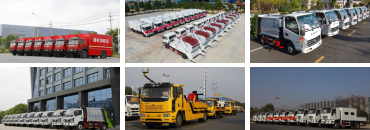
A Complete Guide to Tow Truck Types
Choosing the right tow truck is essential for safe, efficient, and professional vehicle recovery. Different towing scenarios — from roadside assistance to heavy-duty recovery — require specialized equipment. In this guide, we focus on four major tow truck categories widely used in the industry:
Understanding the differences, applications, and advantages of each type will help fleet owners, operators, and customers select the most suitable solution.
1. Flatbed Tow Truck
The Flatbed Tow Truck, also known as a rollback truck, is one of the most widely used and versatile towing vehicles in the industry. It is considered the safest and most protective option for transporting vehicles.

How It Works:
When a vehicle needs to be picked up, the operator uses hydraulics to lower the bed until it touches the ground. If the vehicle is operable, it can be driven onto the bed. If it is disabled, a winch and cables are used to pull it securely onto the platform. Once the vehicle is in place, the bed is raised back to a horizontal position for transport.
Primary Uses and Benefits:
· Maximum Protection: The vehicle is carried completely off the ground, eliminating wear and tear on its tires, drivetrain, or suspension. This makes flatbeds the ideal choice for transporting luxury cars, classic vehicles, or cars with significant damage.
· Versatility: They are perfect for all types of roadside assistance, including engine failures, flat tires, and accident recovery.
· All-Wheel-Drive Friendly: Because all four wheels are off the ground, flatbeds are the safest method for towing all-wheel-drive (AWD) and four-wheel-drive (4WD) vehicles.
Best For:
Roadside assistance, long-distance transport, and moving high-value or inoperable vehicles.
2. Rotator Tow Truck
The rotator tow truck represents the pinnacle of recovery technology. While it shares some features with a standard boom truck, its defining characteristic is a rotating turret mounted on the bed, which allows the boom to swing a full 360 degrees.

How It Works:
Equipped with a powerful telescopic boom that can rotate independently of the chassis, the rotator provides incredible flexibility and power. The operator can position the boom at any angle around the truck to precisely lift and pull loads without having to constantly reposition the entire vehicle. It uses advanced hydraulic systems and outriggers for stability.
Primary Uses and Benefits:
· Unmatched Lifting Capacity: Rotators are designed for the most challenging heavy-duty recoveries, such as overturned tractor-trailers, buses, and other large vehicles in precarious positions.
· Precision and Safety: The 360-degree rotation allows for safe and controlled lifting in tight spaces, like accident scenes in intersections or on narrow highways, without destabilizing the recovery vehicle.
· Single-Vehicle Solution: Often, a rotator can perform the work that would otherwise require multiple standard tow trucks, saving time and resources.
Best For:
Complex heavy-duty recovery, large commercial vehicle accidents, and jobs requiring extreme lifting power and precision.
3. Integrated Tow Truck
Often referred to as a self-loader or a “snatcher,” the integrated tow truck is a purpose-built heavy-duty machine. Unlike a standard wheel-lift truck that is added to a commercial chassis, an integrated truck is designed from the ground up for towing. It combines a powerful boom with a robust wheel-lift system.

How It Works:
Integrated trucks feature an underlift or wheel-lift unit that can slide under a vehicle to lift it by the wheels. Simultaneously, they have a strong boom for recovery operations. The truck is built with an extra axle and a reinforced frame to handle the immense strain of hauling heavy loads. Operators can often control the entire pick-up process from inside the cab.
Primary Uses and Benefits:
· Heavy-Duty Hauling: These trucks are the go-to choice for towing large vehicles like buses, RVs, motorhomes, and heavy commercial trucks.
· Dual Functionality: They are equally adept at recovery operations, such as pulling a large vehicle out of a ditch, and transporting it to a repair facility.
· Stability and Power: The integrated design and extra axles provide superior stability and lifting capacity compared to lighter-duty trucks.
Best For:
Towing and recovering buses, semi-trucks, and other large, heavy vehicles.
4. Tow Truck with Crane (Boom Truck)
A tow truck with a crane, commonly known as a boom truck, is distinct for its powerful, hydraulic arm—the “boom.” While hook-and-chain trucks use a boom for lifting, modern boom trucks often utilize slings, belts, or lift plates to secure a vehicle, minimizing damage.

How It Works:
The hydraulic boom can be extended and angled to reach vehicles in difficult spots. A cable and hook system on the end of the boom is used to lift the vehicle. The boom’s design helps keep the truck balanced while hoisting heavy loads. Modern operators typically use nylon slings or belts instead of chains to cradle the vehicle’s frame or wheels.
Primary Uses and Benefits:
· Recovery from Difficult Locations: The extended reach of the boom makes these trucks perfect for extracting vehicles that have gone off-road, down embankments, or into ditches.
· Heavy Lifting: They are excellent for lifting heavy objects and are useful for tasks beyond just vehicle recovery.
· Versatility: While not ideal for daily street parking enforcement, they are essential for challenging recovery scenarios where a standard wheel-lift truck cannot reach.
Best For:
Off-road recovery, pulling vehicles from ditches or embankments, and heavy-duty lifting tasks.
Choosing the Right Tool for the Job
The diversity in tow truck design highlights the complexity of the recovery industry. Whether it’s the gentle transport provided by a Flatbed, the brute force of an Integrated truck, the precise power of a Rotator, or the extended reach of a Tow Truck with Crane, each type plays a critical role in keeping our roads safe and clear. For towing professionals, investing in the right mix of equipment is essential for handling any challenge the road presents.